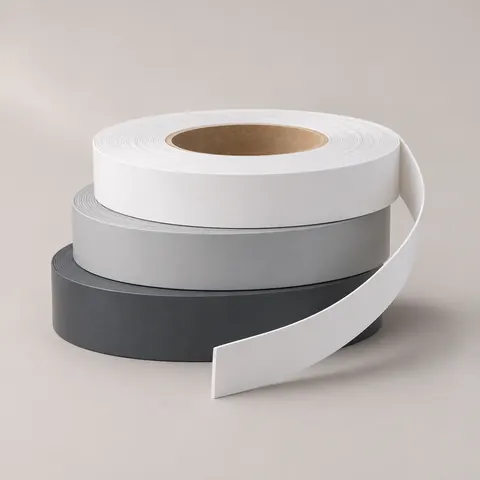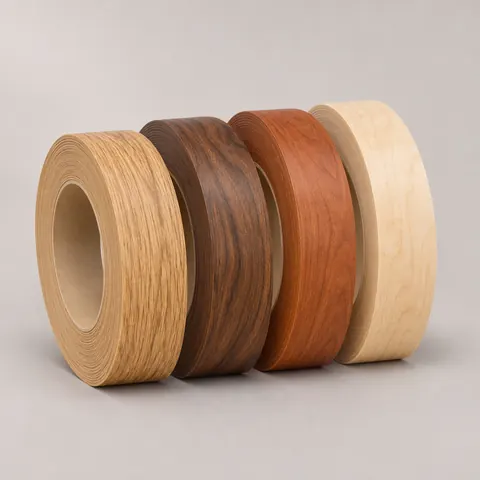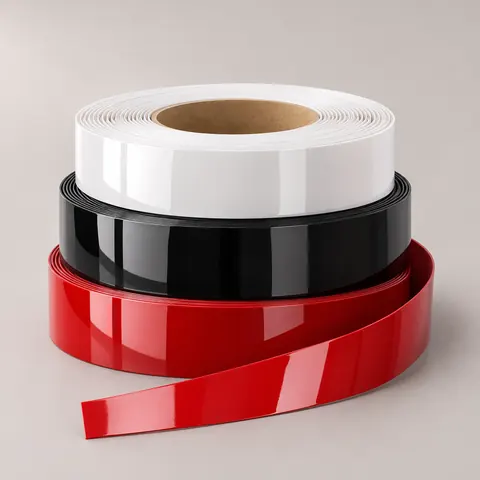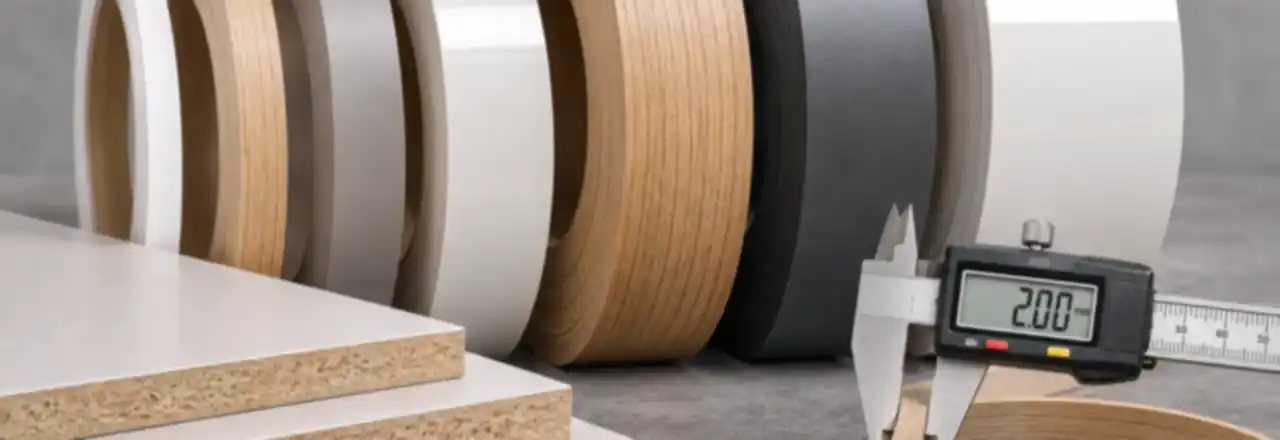
Order edge banding 3–5 mm wider than the board thickness (22 or 23 mm for 18 mm board) and choose thickness by wear: 0.4–0.6 mm for hidden edges, 1 mm for standard doors and carcasses, and 2–3 mm for desks, worktops and high-traffic edges.
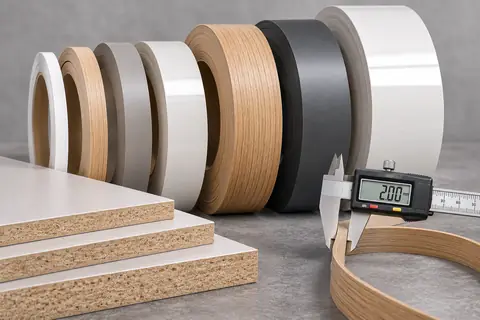
Choosing the width
Edge banding is always a little wider than the board so the edge bander can trim it flush on both faces. The overhang is usually 1.5–2.5 mm per side.
| Board thickness | Recommended width |
|---|---|
| 8–10 mm | 12–15 mm |
| 12 mm | 16–17 mm |
| 15–16 mm | 19–21 mm |
| 18 mm | 22–23 mm |
| 19 mm | 23–24 mm |
| 25 mm | 28–30 mm |
| 36–38 mm (double) | 40–42 mm |
Choosing the thickness
- 0.4–0.6 mm: shelves, back edges, internal parts. Lowest cost per metre.
- 0.8–1.0 mm: the standard for doors, carcasses and visible edges.
- 2 mm: desk tops, worktops, school and office furniture. A 2 mm edge can be radiused to R2 for a soft, durable corner.
- 3 mm: heavy-duty shelving, retail fixtures and commercial furniture.
Roll lengths
Thin edges come in longer rolls. Our standard is 200 m per roll for 0.4–0.8 mm and 100 m per roll for 1–3 mm. Jumbo rolls of up to 600 m are available for automatic lines that stop less for roll changes.
Estimating how many metres to order
Add up the perimeter of every banded edge, then add 8–10% for trimming waste and machine start-up. For a typical 600 mm kitchen base cabinet with a banded door, two sides, a bottom and a shelf, expect about 7–9 m of edge banding. Use our edge banding calculator for a quick estimate.
Frequently asked questions
What width edge banding do I need for 18 mm MDF?
22 mm or 23 mm. The extra width is trimmed flush on both faces.
Is thicker edge banding always better?
No. Thicker edges are more durable but cost more and need a radius scraper. Use 1 mm for most visible edges and 2 mm where furniture is knocked.